


 Let Us Call You


Melanoma is the most serious form of skin cancer, developing in the melanocytes which are the cells responsible for producing the pigment that gives skin its color. While it is less common than other skin cancers, it is far more likely to grow and spread if not treated early. Understanding its development is crucial for prevention, as the disease can occur anywhere on the body, including areas that are not frequently exposed to sunlight.
What is Melanoma?
The development of melanoma cancer occurs when DNA damage typically from ultraviolet radiation triggers mutations in melanocytes, leading to uncontrolled cellular growth. This malignancy can manifest as a new growth or as changes to an existing mole, often appearing on the back in men or the legs in women. Because of its potential to move deeper into the skin and reach the bloodstream, early detection is the primary factor in determining a patient's outcome.
Causes of Melanoma Symptoms
The onset of melanoma symptoms is most frequently attributed to cumulative or intense exposure to UV radiation. Several factors contribute to the cellular DNA damage that triggers these symptoms:
- UV Radiation: Excessive exposure to natural sunlight or artificial sources like tanning beds.
- Genetic Predisposition: A family history of skin cancer or having fair skin, light eyes, and red/blond hair.
- High Mole Count: Having more than 50 typical moles or any atypical (dysplastic) nevi.
- Immune Status: A weakened immune system due to medical conditions or specific medications.
Melanoma Symptoms
A change in the size, shape, or color of an existing mole is often one of the first signs of melanoma to appear on the skin. Patients should stay alert for the following localized changes:
- Any existing spot that starts to change its texture, height, or surface appearance.
- New sensations such as persistent itching, tenderness, or a burning feeling.
- Oozing, bleeding, or the development of a scaly or crusty texture.
- A dark, vertical streak or bruise-like mark appearing under a fingernail or toenail.
Signs Of Melanoma
It is important to watch for an amelanotic melanoma, which can be misleading as it appears pink or skin-colored rather than dark. For most other cases, medical professionals recommend the ABCDE rule to identify warning signs:
- One half of the mole or birthmark does not match the other half.
- The edges are irregular, ragged, notched, or blurred rather than smooth.
- The pigmentation is not uniform and includes different shades of brown, black, red, or blue.
- The spot is larger than 6mm (about the size of a pencil eraser).
- The mole is actively changing in size, shape, color, or is bleeding/crusting.
Melanoma Stages
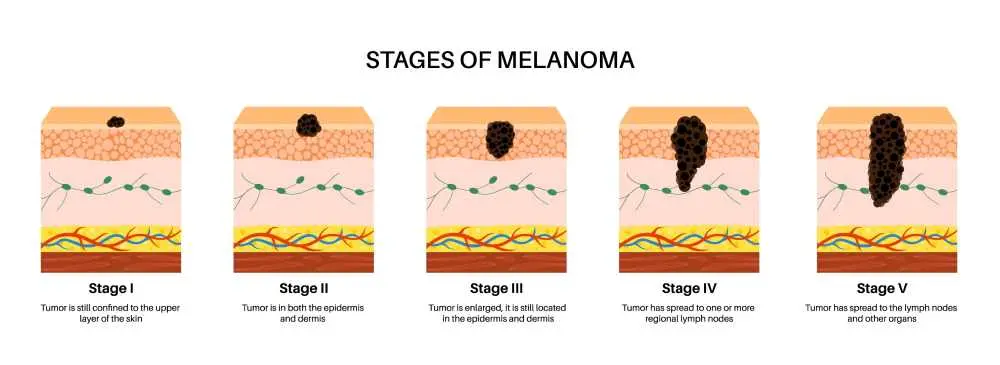
Proper melanoma staging is determined by the thickness of the primary tumor and whether the cancer has reached nearby lymph nodes or distant organs. Doctors use this system to categorize the disease from a scale of 0 to IV, providing a framework for choosing the most effective therapy. As the thickness increases, the risk of the cancer infiltrating the lymphatic system or the circulatory system grows, making the initial measurement critical.
Melanoma Diagnostic Methods
An early stage melanoma is typically diagnosed through a physical skin exam followed by a biopsy, where the suspicious tissue is removed for laboratory analysis. Specialists then utilize melanoma pathology to examine the cells under a microscope, determining the "Breslow thickness" and the rate of cell division. If the cancer is suspected to have moved beyond the skin, imaging tests like CT scans or sentinel lymph node biopsies are used to track its path.
Melanoma Treatment
The management of metastatic melanoma has evolved significantly, now incorporating advanced therapies such as immunotherapy and targeted drugs alongside traditional options. These treatments work by either boosting the body's immune response to fight the cancer cells or by attacking specific genetic mutations within the tumor itself. Radiation therapy may also be utilized in specific cases where the cancer has spread to the brain or bones to alleviate symptoms and control growth.
Melanoma surgery
A specialized melanoma surgery known as wide local excision is the standard first-line treatment, involving the removal of the tumor along with a margin of healthy skin. Depending on the depth of the lesion, the surgeon might also perform a sentinel node biopsy during the same procedure to check for microscopic spread. In more advanced cases, a lymph node dissection or the surgical removal of distant metastases may be necessary to reduce the overall tumor burden in the body.
Which medical department should be consulted for melanoma?
Individuals should schedule an appointment with a Dermatology department for skin screenings and the initial diagnosis of suspicious lesions.


