


 Let Us Call You


Glaucoma is a group of disease that causes permanent vision loss and blindness by leading to an increase in intraocular pressure. It is most commonly seen in adults aged 50 and over. This condition may arise as a result of many different causes and has a treatable nature. Being aware of the risk factors and acting accordingly, as well as undergoing regular eye examinations, can help prevent vision loss.
Key Takeaways
- Glaucoma is a leading cause of vision loss worldwide and often develops without early symptoms. Regular eye examinations are essential for early diagnosis and preventing permanent vision damage.
- Treatment focuses on lowering intraocular pressure to protect the optic nerve. The most common options include prescription eye drops, laser treatment, and surgery.
- Turkey offers advanced glaucoma diagnosis and treatment options. Many clinics provide modern technologies and experienced ophthalmologists for international patients.
What is Glaucoma?
Glaucoma is an eye disease that damages the optic nerve, usually caused by abnormally high pressure inside the eye (intraocular pressure). Because it often progresses without noticeable symptoms, it is known as the “silent thief of sight.”
However, in later stages, blurred vision, severe headaches, and narrowing of the visual field may occur. Glaucoma is the second leading cause of blindness worldwide.
In many types of glaucoma, especially when diagnosed early, treatment is possible. With proper attention and care, it is possible to delay or even prevent permanent vision loss.
What Are the Symptoms of Glaucoma?
Glaucoma may not show symptoms in its early stages and is therefore also referred to as the silent thief of vision. It usually develops slowly and painlessly, leading to gradual vision loss. If left untreated, it may result in permanent blindness. In addition, it may cause serious symptoms that require urgent medical care, such as severe eye pain, headache, nausea, and blurred vision.
Symptoms may vary depending on the type of glaucoma
Open-Angle Glaucoma
This is the most common type of glaucoma. There are usually no symptoms in the early stages. Over time, patchy blind spots develop in peripheral vision. In advanced stages, central vision may also be affected.
- Blood accumulation in the pupil
- Protrusion of the eyeballs
- Nausea occurring together with eye pain
- Rainbow-colored halos around lights
- Floating objects in the eye
- Sudden loss of vision
- Sudden flashing lights in the field of vision
Acute Angle-Closure Glaucoma
This is a type of glaucoma that requires emergency intervention. It may cause severe and sudden eye pain or pressure, headache, nausea, or vomiting.
- Sudden, severe blurred vision
- Halos around lights
- Redness in the eye are among its other symptoms
Symptoms of glaucoma in children
Cloudy eyes, excessive blinking, tearing, or worsening myopia may be observed.
If severe and sudden eye pain, headache, nausea, and blurred vision occur, it is necessary to seek emergency medical care. Regular and comprehensive eye examinations are the only way to diagnose the disease early. For this purpose, you may consult the ophthalmology department.
What Causes Glaucoma?
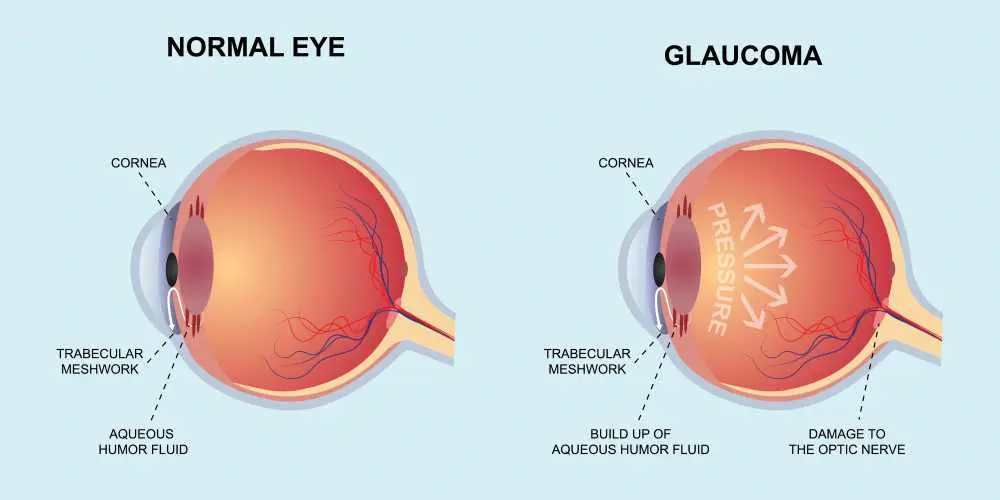
Glaucoma occurs due to damage to the optic nerve. This damage usually results from improper drainage of the fluid inside the eye. As a result, intraocular pressure increases and may lead to blindness.
Main causes and risk factors:
High Intraocular Pressure
It is the most common cause of glaucoma. Pressure increases when the eye fluid cannot drain properly through the trabecular meshwork.
Open-Angle Glaucoma
The drainage angle remains open, but the drainage system gradually becomes less effective over time.
Angle-Closure Glaucoma
The iris bulges forward and partially blocks the drainage angle. This leads to sudden or gradual increases in eye pressure.
Normal-Tension Glaucoma
Even when intraocular pressure remains within the normal range, the optic nerve becomes damaged. This condition is likely related to insufficient blood flow or a fragile optic nerve.
Risk factors include being over the age of 60, family history, diabetes, high blood pressure, severe myopia, hyperopia, and eye injuries.
How is Glaucoma Diagnosed?
Glaucoma can be diagnosed at an early stage through routine examinations. This is identified through an eye examination performed after dilating the pupil. The main tests include measuring intraocular pressure (tonometry), examining the drainage angle (gonioscopy), imaging the optic nerve (OCT), evaluating peripheral vision (visual field test), and measuring corneal thickness (pachymetry).
Glaucoma diagnostic tests can be listed as follows:
- Tonometry: Measures intraocular pressure to detect elevated pressure inside the eye.
- Optic Nerve Evaluation: The pupil is dilated to examine possible damage to the optic nerve.
- Visual Field Test (Perimetry): Evaluates peripheral (side) vision to detect blind spots.
- Gonioscopy: A special lens is used to examine the drainage angle of the eye in order to determine the type of glaucoma.
- Pachymetry: Measures the thickness of the cornea, which may affect intraocular pressure measurements.
- Optical Coherence Tomography (OCT): Detects damage by examining three-dimensional images of the optic nerve and the retinal nerve fiber layer.
How is Glaucoma Treated?
Glaucoma is treated by lowering intraocular pressure in order to prevent further damage to the optic nerve. Common treatment methods include prescription eye drops, laser therapies to improve fluid drainage, or surgery to create new drainage channels.
Common treatment options for glaucoma are as follows:
Prescription Eye Drops
One of the most common treatment methods is eye drops. They reduce eye pressure by decreasing fluid production or increasing its outflow.
Laser Treatment
Procedures such as Selective Laser Trabeculoplasty (SLT) are used to help fluid drain from the eye.
Surgery
If drops and laser treatments are not effective, surgical procedures such as trabeculectomy (creating a new drainage flap) or the placement of small drainage tubes may be performed.
MIGS (Minimally Invasive Glaucoma Surgery)
New procedures such as stent implantation are designed to reduce eye pressure with lower risk, often performed together with cataract surgery.


