


 Let Us Call You



Croup is a common childhood infection that makes the windpipe, voice box and airways swell, causing a barking cough and noisy breathing. It mostly affects children between 6 months and 3 years old and is usually caused by a virus. Most cases are mild, last a few days and can be managed at home, often with a single dose of steroid medicine from a doctor. A child who is struggling to breathe needs emergency care straight away.
Key Takeaways
- Croup causes a harsh, seal-like barking cough and a high-pitched sound when breathing in (stridor).
- Symptoms are usually worse at night and last a few days, occasionally up to 2 weeks.
- A single dose of a steroid medicine is the usual treatment to reduce swelling in the throat.
- Steam inhalation is not recommended, as it does not help and can cause scalds.
What Causes Croup?
Croup is most often caused by a virus, especially the parainfluenza virus, which spreads through coughs, sneezes and close contact. It is more common in late autumn and early winter, and boys are affected more often than girls.
Viral Infection
Most croup follows a cold-like virus that inflames the upper airways. A child can have croup more than once.
Less Common Causes
- Breathing in a small object
- Inflammation of the epiglottis, the flap at the back of the throat
- A severe allergic reaction
- Breathing in irritating fumes
- Acid reflux from the stomach
What Are the Symptoms of Croup?
The main symptom of croup is a loud, barking cough that sounds like a seal. Many children have a few days of cold-like symptoms first.
- A barking cough
- Stridor, a harsh, high-pitched sound when breathing in, often worse when crying
- A hoarse voice
- A runny nose and sore throat
- A high temperature
- Difficulty breathing
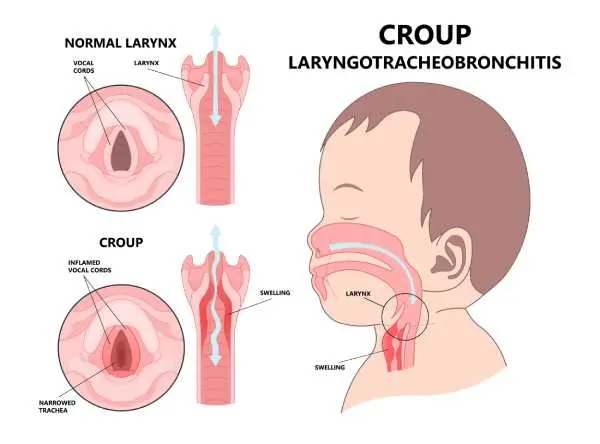
Croup usually lasts a few days, and the cough is often worst at night. In some children the symptoms continue for up to 2 weeks. Croup is uncommon after the age of 6 and rare in adults.
How Is Croup Diagnosed?
A doctor can usually diagnose croup by listening to the cough and breathing, so a short phone recording of the noise can help. A small sensor clipped to a finger or earlobe (pulse oximetry) may be used to check oxygen levels. Do not try to look inside your child's throat, as this can make the airway narrow suddenly.
How Is Croup Treated?
Most children with croup get better at home, and a doctor often prescribes a single dose of steroid medicine to reduce the swelling. Children with more severe breathing difficulty are treated in hospital.
Caring for Your Child at Home
- Keep your child upright and calm, because crying can make breathing harder.
- Offer small, frequent drinks.
- Give children's paracetamol for pain or a high temperature if needed.
- Do not give cough medicines or decongestants.
- Do not use steam, as it does not help and has caused scalds.
Steroid Medicine
A steroid such as dexamethasone or prednisolone, usually given as one dose, reduces swelling around the voice box and eases breathing.
Hospital Treatment
In more severe croup, children may be given adrenaline through a nebuliser or oxygen, and are watched until their breathing settles.
When Should You Worry About Croup?
You should get help quickly if your child's breathing becomes harder or the noisy breathing does not settle. Severe croup is rare but can block the airway.
Call an Ambulance or Go to the Emergency Department If Your Child:
- Is struggling to breathe or breathing very fast
- Is too breathless to feed, drink or talk
- Has skin pulling in around the ribs or at the base of the throat with each breath
- Has blue, grey or very pale skin or lips
- Is unusually drowsy, distressed or agitated
- Is drooling or cannot swallow
Contact a Doctor If Your Child:
- Has a barking cough or stridor
- Is under 3 months old with a temperature of 38°C or above
- Is 3 months or older with a temperature of 39°C or above
If your child has a barking cough, noisy breathing or croup that keeps coming back, an assessment by a pediatrics specialist is advisable.


